Description:
Inventor:
Adrienne P. Rosenthal, MD – Cooper University Health Care
Overview
A handheld, minimally invasive device that combines vacuum-assisted biopsy and cryotherapy in a single procedure for the diagnosis and treatment of suspicious or malignant breast lesions. The system enables tissue sampling and localized ablation while reducing the need for multiple instruments, procedures, and patient visits.
Clinical Need
Current management of suspicious breast lesions typically requires a diagnostic biopsy followed by a separate therapeutic intervention, such as surgical excision or lumpectomy. While vacuum-assisted breast biopsy is widely used for diagnosis, it does not treat the remaining lesion. Cryotherapy is an established treatment modality but generally requires separate equipment and additional needle insertions. There is a need for an integrated system that combines diagnosis and treatment in a single minimally invasive procedure, particularly for patients who may not be ideal surgical candidates.
Solution
The device integrates vacuum-assisted biopsy and cryotherapy for breast lesion management for use during a single procedure. It features multiple configurations: a cryoprobe positioned behind the biopsy needle, a shared probe tip design, and an advanced version with dual side catheters for localized drug delivery (e.g., Tamoxifen via hydrogel).
Technology
A handheld, single-use medical device that combines two key functions—biopsy and cryotherapy—into one tool for diagnosis and treatment of breast cancer. It allows clinicians to collect tissue samples and perform targeted cryoablation in a single, minimally invasive procedure, reducing the need for multiple instruments or steps. The device is designed in different configurations, including models with dual probes or a shared tip design, and can be further enhanced with side cannulas for delivering localized drug therapy directly into the treatment area, stabilized with a hydrogel formulation. Operated under ultrasound guidance, and adaptable for future imaging modalities like CT and MRI, the system is designed to simplify outpatient care while improving precision and safety. By integrating diagnosis and treatment into one device, this technology offers a more efficient and patient-friendly approach to breast lesion management.
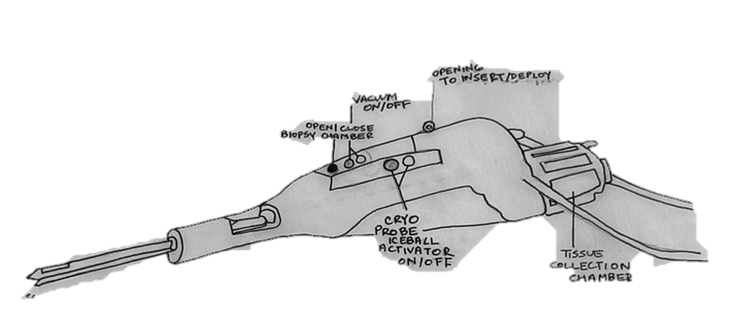
Figure 1. Biopsy cryoablation device schematic showing a handheld, single use, dual-probe device for biopsy and treatment of breast cancer, axillary lymph node, or another target lesion, where the cryoprobe is adjacent to the vacuum biopsy needle.
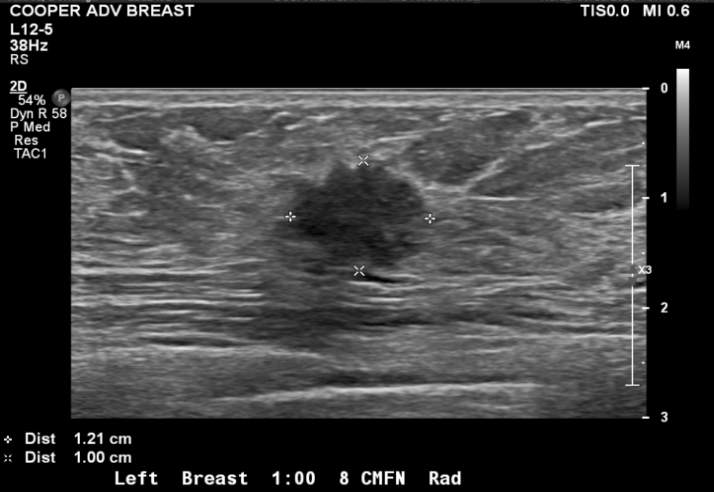
Figure 2. Image shows a 1.2 cm suspicious target lesion example with irregular margins, and the biopsy results of this lesion were positive for malignancy.
Advantages
- Single-pass diagnosis and treatment
- Minimally invasive outpatient procedure
- Reduced need for multiple instruments and procedures
- Potential reduction in local tumor recurrence risk
- Compatible with image-guided workflows
- Potential platform for localized drug delivery
Development
Stage: Concept Development
IP: U.S. Provisional Patent Application (Confidential)
Opportunities
Co-development and licensing partnerships.
Contact
Neal Lemon, PhD, MBA
AVP, Innovation & Technology Commercialization
Cooper University Health Care
lemon-neal@cooperhealth.edu