Description:
Inventors:
Ajith Thomas, MD – Professor, Neurological Surgery, Cooper Medical School of Rowan University
Sai Batchu, MD
Overview
A non-invasive vessel identification system that uses arrays of light-emitting diodes and photodetectors to distinguish arteries from veins based on oxygen saturation measurements. The technology enables real-time vessel localization and tracking in both percutaneous and surgical settings.
Clinical Need
Accurate vascular identification is essential during routine venous access, emergency procedures, critical care interventions, and surgery. Difficulty locating blood vessels can result in failed access attempts, patient discomfort, procedural delays, infection risk, and accidental arterial puncture. Existing approaches lack continuous, real-time vessel mapping capabilities.
Solution
Given that a regular pulse oximeter can calculate oxygen saturation by comparing the absorption of red and infrared light by the blood. Dependent on the amount of oxygenated Hb and deoxygenated Hb present, the ratio of the red-light absorption to infrared light absorption changes. This same principle can be used to detect an artery or vein.
Technology
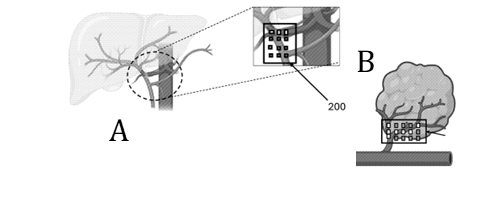
The device is designed to identify peripheral arteries and veins with the use of an array of light-emitting diodes (LEDs) and photodetectors to predict an artery or vein trajectory under a patient’s skin or during open surgery in a region of interest or organ. An innovative array of infrared chips conforming to body contours is used to identify a precise artery or vein location based on measurement of SpO2.
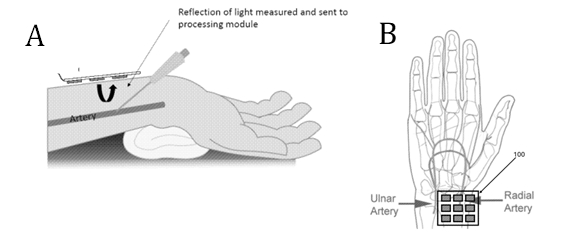
Figure 1A. A schematic displaying a side view of the device measuring blood vessels.
Figure 1B. A schematic displaying a top view of the device measuring blood vessels.
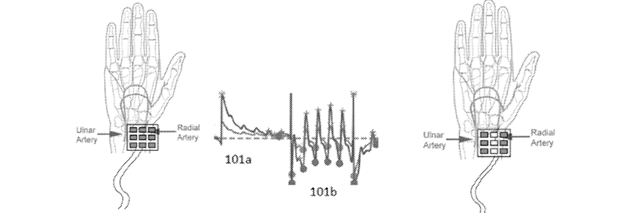
Figure 2 . A diagram of the device describing how the LEDs and photodetector are used to predict the location of arteries. The image on the left displays the device upon placement on a hand. The plot represents the measure of SpO2. The image on the right displays the device readout where shaded squares indicate location of an artery.

Advantages
- Non-invasive vessel identification
- Real-time artery and vein localization
- Improved procedural safety and efficiency
- Reduced risk of failed vascular access attempts
- Continuous vessel tracking capability
- Applicable to bedside and surgical procedures
Development
Stage: Prototype Phase with In-House Testing
IP: U.S. Provisional Patent Application Filed
Opportunities
Co-development and licensing partnerships.
Contact
Neal Lemon, PhD, MBA
AVP, Innovation & Technology Commercialization
Cooper University Health Care
lemon-neal@cooperhealth.edu