Description:
Inventors:
Sangita Phadtare, PhD – Professor, Biomedical Sciences, Rowan University
Lark J. Perez, PhD – Professor and Chair, Chemistry & Biochemistry, Rowan University
Joshua DeSipio, MD – Gastroenterologist, Cooper University Health Care
Overview
A point-of-care diagnostic platform that detects Helicobacter pylori infection using biomarkers associated with alterations in fecal fatty acid metabolism. The technology provides a non-invasive approach for diagnosis and may also inform treatment decisions by predicting antibiotic resistance.
Clinical Need
H. pylori infects up to half of the global population and is a major contributor to gastritis, peptic ulcer disease, gastric lymphoma, and gastric cancer. Current diagnostic approaches often require invasive endoscopy, specialized testing, or centralized laboratory infrastructure, creating barriers to timely diagnosis and treatment, particularly in underserved populations.
Solution
The inventors identified a diagnostic biomarker for H. Pylori infection based on changes in fecal fatty acid metabolism to be used in a point-of-care test. The diagnostic biomarker provides actionable information to guide targeted therapies and mitigate antibiotic resistance.
Technology
Dr. Phadtare, Dr. Perez, and Dr. DeSipio have characterized the metabolome in H. Pylori patients, specifically the interactions between H. Pylori and fecal fatty acid metabolism. In an exploratory research study, a significant decrease in polyunsaturated fatty acid (PUFA) C18:3n6 was observed in the stool of H. Pylori patients. In addition to detecting the presence of H. Pylori, these diagnostic markers can be used to assess and predict antibiotic resistance in patients, which can improve patient outcomes by guiding targeted therapies and mitigating the effects of increased antibiotic usage.
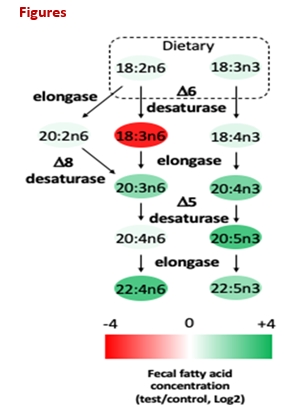
Fig 1. Changes in fatty acid concentration mapped onto de novo biosynthetic pathways. Diminished (red) or increased (green) fatty acids in patients with H. pylori compared to control (healthy) samples.
Advantages
- Non-invasive stool-based testing
- Point-of-care diagnostic potential
- Predictive of antibiotic resistance
- Enables targeted therapy selection
- Addresses healthcare access disparities
- Potential to improve patient outcomes while limiting unnecessary antibiotic use
Development
Stage: In Vivo Proof of Concept
IP: U.S. Provisional Patent Application Filed.
Opportunities
Co-development and licensing partnerships.