Description:
Lead Program: HydroBone™ – Injectable osteogenic hydrogel for bone regeneration and fracture healing
Inventors:
Sebastián L. Vega, PhD – Assistant Professor, Biomedical Engineering, Rowan University; CEO
Tae Won B. Kim, MD – Assistant Professor, Orthopedic Surgery, Cooper University Health Care; CTO
Matthias Recktenwald, PhD – Rowan University; CSO
Overview
HydroPep Therapeutics is developing injectable biomaterials that deliver tissue-specific therapeutic peptides directly to sites of injury or tissue loss. Its lead program, HydroBone™, is an injectable osteogenic hydrogel designed to promote bone regeneration and fracture repair through localized biologic signaling delivered via minimally invasive injection.
Clinical Need
Many regenerative medicine therapies rely on invasive surgical procedures, tissue grafting, or systemic biologics that lack precise localization to the injured tissue. These approaches may lead to off-target effects, inconsistent efficacy, elevated costs, and prolonged recovery times.
In orthopedic applications such as fracture repair and osteoporosis-related bone loss, there remains a significant need for minimally invasive therapies that can enhance bone healing while reducing patient morbidity and surgical burden.
Solution
HydroPep's platform enables localized delivery of bioactive peptide therapeutics through injectable hydrogel biomaterials. The technology provides controlled therapeutic activity directly at the site of injury, supporting tissue repair while minimizing systemic exposure.
HydroBone represents the first therapeutic application of the platform and is being developed as a regenerative therapy to stimulate bone formation and accelerate fracture healing through localized biologic signaling.
Technology
The platform is based on injectable, modified hyaluronic acid hydrogels that rapidly crosslink in situ to form biocompatible matrices. These hydrogels can be functionalized with therapeutic peptide sequences, including growth factor mimetics that provide sustained localized signaling at sites of tissue injury.
Preclinical studies have demonstrated enhanced osteogenic activity in vitro and increased trabecular bone formation in vivo following localized delivery of osteogenic peptide-functionalized hydrogels. The modular design allows therapeutic peptides, biologic activity, and material properties to be independently optimized for multiple regenerative medicine applications beyond bone repair.
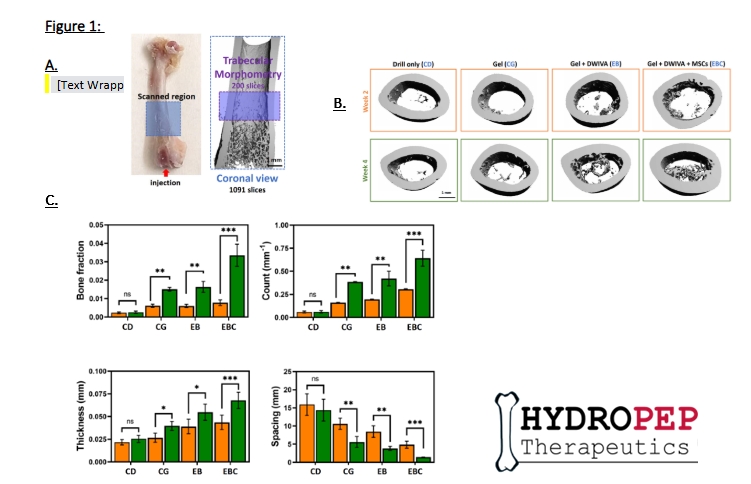
Figs. 1A-1C HydroBone. Demonstration that DWIVA-functionalized hydrogels induce trabecular bone growth in vivo. Fig. 1A: the sites of injection and CT imagining. Fig. 1B: comparison of drilled femurs not treated with hydrogel (“CD”), treated with hydrogels not functionalized with DWIVA peptide and without mesenchymal stem cells (“CG”), treated with hydrogels functionalized with DWIVA peptide but without mesenchymal stem cell (“EB”), or treated with hydrogels functionalized with DWIVA peptide and includes mesenchymal stem cells (“EBC”) at two weeks and four weeks. Fig. 1C: quantification results for Fig. 1B. Bar graphs are shown as mean ± SD, (n ≥ 3 samples per condition) with nonsignificant differences denoted as ns, and significant differences determined with ANOVA followed by Tukey’s post hoc test where *p < 0.05, **p < 0.01, ***p < 0.001. Scale bars: (A,B) 1 mm.
Advantages
Development
Stage: In Vivo Proof-of-Concept
IP: U.S. Provisional Patent Application Filed
Opportunities
Co-development, licensing, strategic investment, and platform partnership opportunities.
Contact
Neal Lemon, PhD, MBA
AVP, Innovation & Technology Commercialization
Cooper University Health Care | Rowan University
lemon-neal@cooperhealth.org | lemonna@rowan.edu