Inventor
David D. Shersher MD, Surgery, MD Anderson Cancer Center at Cooper
Wissam Abouzgheib MD, Pulmonary Medicine, MD Anderson Cancer Center at Cooper
Overview
The Body Cavity Evacuator (BCE) is a minimally invasive device designed to efficiently perfuse and remove highly viscous fluids from body cavities, particularly the pleural space, through a single access point. The system combines simultaneous irrigation and drainage capabilities to improve management of difficult-to-treat fluid collections such as pleural empyema.
Clinical Need
Pleural empyema is the accumulation of infected purulent fluid within the pleural cavity, commonly arising from pneumonia, injury, or thoracic surgery. Approximately 32,000 cases occur annually in the United States, and the condition is associated with substantial morbidity and mortality. An estimated 20–30% of affected patients either die or require additional surgery within one year of diagnosis. Early and effective drainage is critical to controlling infection and improving outcomes.
Current drainage methods are often ineffective for highly viscous fluids and may require multiple access sites, making procedures more invasive, complex, and cumbersome for both clinicians and patients. Improved approaches are needed to enhance drainage efficiency while minimizing procedural burden.
Solution
The Body Cavity Evacuator enables simultaneous irrigation and suction through a single point of entry. By facilitating both perfusion and drainage in one integrated device, the system improves evacuation of viscous collections while reducing procedural complexity and invasiveness.
Technology
The BCE utilizes a novel dual pigtail catheter configuration in which one catheter provides perfusion while the second independently drains fluid. Both catheters are housed within a single tear-away sheath that allows straightforward deployment through a single access site. Once deployed, the spatially opposed pigtail design maximizes cavity coverage and enhances fluid exchange, enabling more effective evacuation of thick infectious material.
Advantages
- Single access point for simultaneous irrigation and drainage
- Improved management of highly viscous fluid collections
- Opposed pigtail design maximizes body cavity coverage
- Less invasive than multi-access drainage approaches
- Simplified deployment and procedural workflow
Development
Stage: Design Stage
IP: U.S. Utility Patent Application Published; European Patent Application Filed
Opportunities
Co-development and licensing partnerships.
Contact
Neal Lemon, PhD, MBA
AVP, Innovation & Technology Commercialization
Cooper University Health Care | Rowan University
lemon-neal@cooperhealth.org
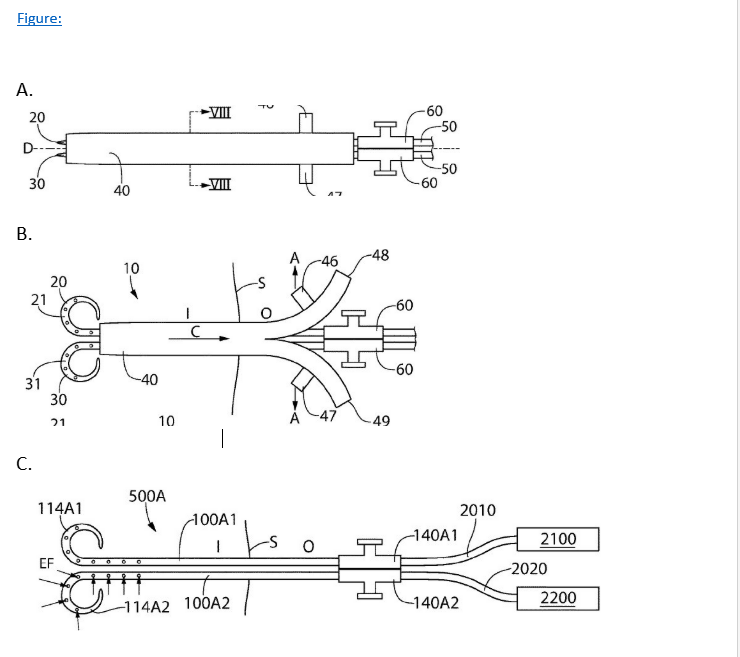
Side view of the Body Cavity Evacuator (BCE) device with spatially opposed pigtail catheters, each with separate lumen, A. encapsulated within a tear-away sheath, B. in the process of having the sheath removed and catheter being deployed and C. catheter fully deployed. The separate lumen of the pigtail catheters allow for independent and simultaneous perfusion and suction from the body cavity. Source: US Patent Application Publication US 2020/0078568